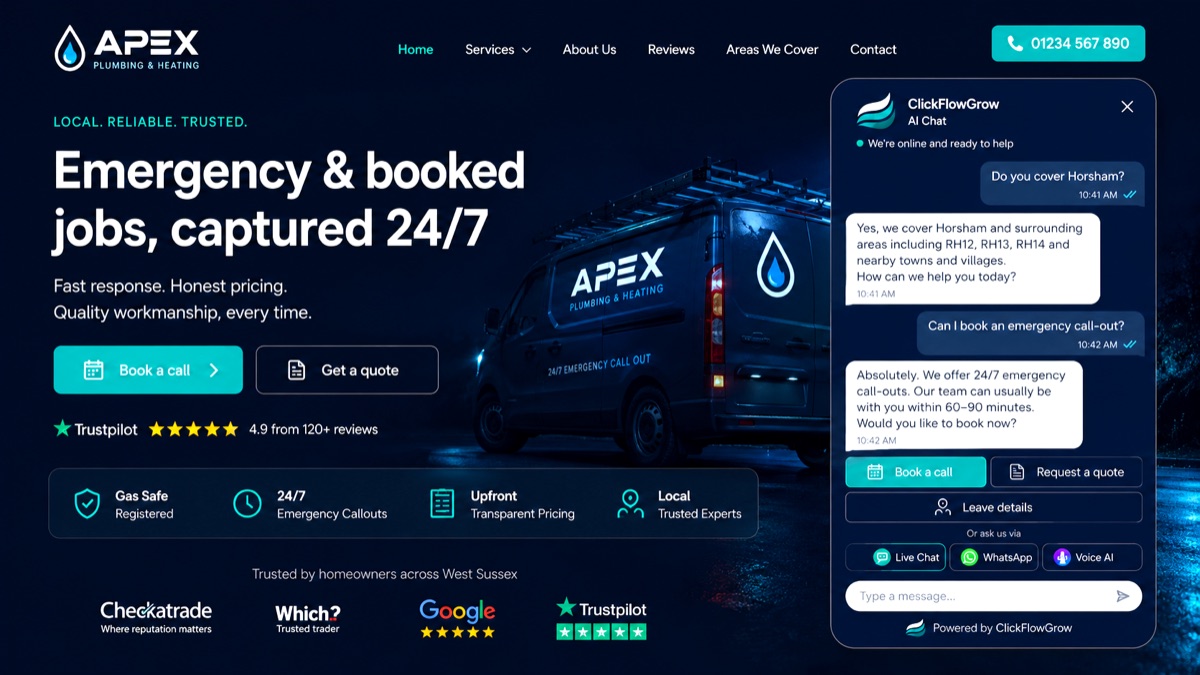
Choose a chatbot that can be grounded in your approved business knowledge, connected to a clear human handover and tested against real customer questions. Treat design, CRM capture, privacy and ongoing review as part of the product—not extras.
A chatbot often meets a visitor before anyone in the business does. That makes its boundaries, tone and next-step logic as important as its ability to produce an answer.
1. Start with the customer questions
List the questions people repeatedly ask before they enquire, book or buy. A useful first version should handle a bounded set well rather than claim to answer everything. Include obvious questions, vague wording and the awkward exceptions that normally need a person.
2. Check where its knowledge comes from
Ask how approved information is added, reviewed and updated. The assistant should distinguish what the business has confirmed from what it cannot verify. It should not make up prices, availability, policies, integrations or guarantees.
3. Design the handover before the happy path
Decide what happens when the visitor is upset, asks a sensitive question or needs judgement. A handover might open a contact route, create a task or pass the conversation to a person. The visitor should understand what will happen next.
- Common questions are answered in plain language.
- Unknown or sensitive questions trigger a safe response.
- The visitor can reach a person without starting again.
- Captured details arrive in the correct CRM record.
- Consent and privacy wording match the information collected.
- The chatbot works on mobile and does not cover key page controls.
4. Look beyond the chat window
The conversation is only one part of the journey. If a visitor gives permission and shares useful details, those details should reach the right place. A connected setup can create or update a contact, record the question and support a defined next action.
5. Test the customer experience
Test at least three groups: people who know exactly what they want, people who describe a problem in their own words, and people whose request is outside scope. Review the accuracy, tone, speed, capture and handover. Repeat the test whenever the knowledge or workflow changes.
Questions to ask a supplier
- Can we control the source information and prohibited claims?
- How are unanswered questions identified and reviewed?
- Can the visitor reach a human with the context preserved?
- What CRM actions happen, and what requires consent?
- How are usage, performance and failures monitored?
A good chatbot should reduce uncertainty for the visitor and make the next human action easier. If it merely adds another conversation window, it has not solved enough.