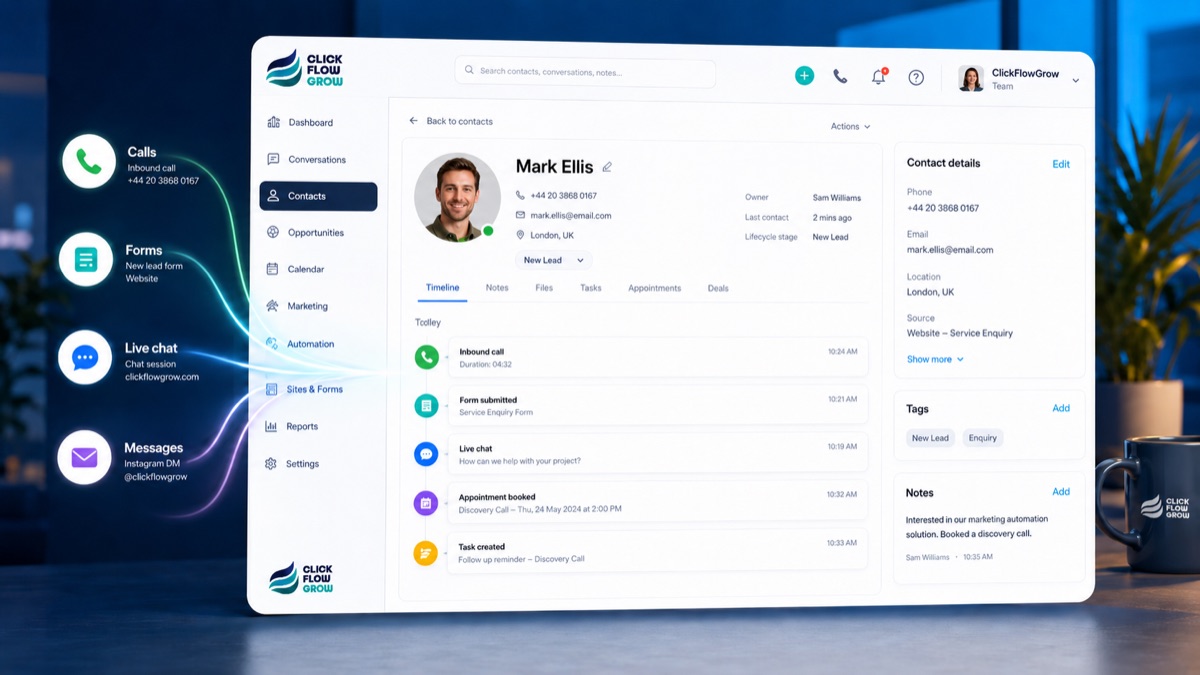
In the first few minutes after an enquiry, acknowledge it, save the customer's context, assign an owner and set a realistic next step. An automated acknowledgement can help, but it should not pretend the enquiry has been personally reviewed when it has not.
A new enquiry is a small moment with a lot resting on it. Someone has paused, explained what they need and chosen to contact your business. Silence leaves them wondering whether the message arrived. A rushed sales sequence can feel just as disconnected.
Five minutes is a useful design test, not a magic deadline. The aim is to make the customer feel received and make the enquiry visible to the person who can take responsibility for it.
Minute 0–1: confirm that the enquiry arrived
Start with a clear acknowledgement on the same journey the person used. A form can show an on-page confirmation and send a short email. A chat can confirm that the message has been recorded. A missed call can move into an agreed call-back process.
The wording should be honest. If nobody has read the enquiry yet, say that it has been received—not that the team is already working on it.
Minute 1–2: keep the useful context together
The customer's name, contact route, original message, source page and consent should reach one deliberate record. The next person should not need to search several inboxes or ask the customer to repeat information they have already supplied.
- Keep the original question or request intact.
- Record when and where the enquiry arrived.
- Preserve the contact route the person chose.
- Avoid collecting extra information simply because the system allows it.
Minute 2–3: decide who owns the next action
An inbox is not an owner. Route the enquiry to a named person, team or queue and make the expected action visible. Routine questions may follow a standard path; urgent, sensitive or unusual requests should reach a person sooner.
If the business is closed, ownership can begin on the next working day. The customer should still know what response window to expect.
Minute 3–5: give a clear and realistic next step
A useful acknowledgement tells the customer what happens now. That might be a call during business hours, a link to choose a suitable appointment, or a promise that a named team will review the details by a stated time.
Make only promises the business can reliably keep. “We’ll reply shortly” is less useful than a truthful expectation such as “We’ll review this when we open tomorrow and respond by midday.”
What should the first message say?
A simple acknowledgement can be enough:
Thanks for getting in touch with [business name]. We’ve received your enquiry about [topic]. [Person or team] will review it and reply by [realistic time]. If your request is urgent, please use [approved route].
The bracketed details should come from trusted information. If the topic cannot be identified reliably, leave it out rather than guessing.
What changes outside working hours?
The purpose stays the same: acknowledge, preserve context, assign ownership and set expectations. The difference is that the next human action may happen later.
After-hours automation can help explain opening times, offer a suitable booking route or collect a small amount of useful context. It should not present routine support as emergency cover or commit the business to a response time it cannot meet.
Where should a person remain involved?
A person should take over when the request needs empathy, technical judgement, negotiation, a complaint response or a decision outside agreed rules. Automation can organise the handover and carry the context; it should not conceal the boundary.
Five common first-response mistakes
- Sending a long sales sequence before understanding the enquiry.
- Leaving the message in a shared inbox without a clear owner.
- Asking the customer to repeat information already captured.
- Promising a response time the team cannot consistently meet.
- Switching channels without a valid reason or the appropriate permission.
A ten-minute check for your own business
- Send a test enquiry through each public contact route.
- Read the confirmation from the customer's point of view.
- Check where the full message and contact details are stored.
- Confirm exactly who receives it and who owns the next action.
- Compare the promised response time with what actually happens.
The goal is not instant selling. It is a calm, connected beginning that respects the customer's effort and makes follow-up easier for the business.